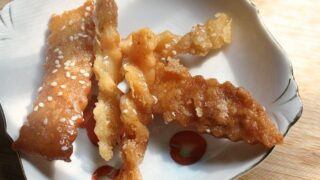
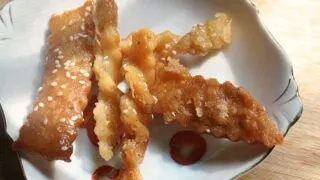
I first heard about corn grit couscous from Paula Wolfert (trust me she’s my catalyst to so many uncovered corners of Moroccan cooking). I was apprehensive. I was puzzled. I really didn’t think it would be good – at all. The image I have of grits is a gooey sticky mess with some butter and salt and pepper, certainly not the fluffy tender consistency I associate with a good couscous. But, we can’t eat regular couscous anymore because it’s made of wheat. I surrendered to my fear of lumpy corn grits and trusted that this would turn out. It did. The best part, I actually like the taste of the corn couscous as much, and maybe even more than traditional couscous.
I used Bob’s Red Mill corn grits (also known as polenta). You will notice that the grains are smaller than couscous. This immediately worried me because the holes in my couscousierre are way too big. I knew that 50% of this would fall through the holes. So instead of just adding it to the top of the pot I lined the top of the couscousierre with a thin dish towel that would allow the steam to get through keep the corn grains from falling below.
Before steaming the first time, I spread the grits out into a large bowl and added 1/4 to 1/2 cup of salt water and separated the grains as much as possible. You may need to add more water, they really should be quite damp but not dripping liquid. Fill the bottom of the couscousierre half-full of water. Transfer the corn grits to the top of the vessel and turn the stove temperature to high. Traditionally, the vegetables and meat that go on top of the couscous simmer in the pot below the steaming couscous, but because I was using shrimp this wouldn’t work. Boiling water beneath will work fine for this recipe. Cover the top of the pot with a lid and leave alone for about 20 minutes. At this point check the grains. If they feel dry then remove and pour back into the bowl you originally used. Add more of the salt water and continue the process the same way you did the first time, taking care to separate the grains as much as possible. Just as with traditional couscous you will steam the grits 3 times.
During the third and final steaming prepare the shrimp. What you’ll need;
The sauce for this couscous is really very simple. In a large skillet heat the oil and add the garlic. Once softened, pour the pureed tomato, cumin, salt, and harissa, parsley and cilantro to the pan and mix well. Slowly pour the stock into the tomato sauce and bring the heat up. Once the sauce is bubbling the shrimp and peas can be added. It will only take a few minutes for the shrimp to cook and peas to warm through. The sauce should have a thinner consistency.
Remove your corn grits once their final steaming is done, and pour into a large serving dish. Use your fingers or a fork to separate the grains as much as possible. Top with the shrimp and sauce. Serve immediately with a large spoon for each diner. You can also have extra harissa at the table for an added zing!
I am really looking forward to making other couscous dishes with corn grits, and think that it also would make a great side dish with other meals.
Have you ever eaten corn couscous? What else would you make with this ingredient?
Last weekend both of my boys had Friday off of school. I have been busy with work lately and MarocBaba has been weighed down with school but we wanted to do something fun for the boys. Let’s face it we both needed a break from the daily grind too. Friday morning we packed up a lunch and went to the Minnesota Zoo. You have to know that K loves animals. He’s nuts for animals and so the zoo was sure to appeal to him. Apparently we had the same idea as half the state of Minnesota because once we got to the zoo, it took us nearly 30 minutes just to get through the gates. The weather was supposed to be nice but after an unseasonably warm spring it felt cool.

We spent the entire day there and had time to visit the Middle Eastern grocery store on our way out of town. Once we were home we were all left with a chill. This in-between season when it’s not really winter and it’s not quite spring yet sometimes leaves me scrambling for what to make. We needed something warm but not something heavy. I have been hunting for new ideas for Moroccan recipes and this was one my mother-in-law suggested. I was skeptical but in the end I loved it too.
The base for this soup is Saffron Roads’ Classic Culinary Vegetable Broth. The ingredients that make up the broth compliment the ingredients and add a little extra flavor. This recipe is gluten-free, low fat and very inexpensive. When I began cooking this I was immediately overcome by how the ginger comes through in the smell and taste (in a good way!) If you can, use fresh grated ginger – it will make a huge difference and is worth the little extra effort.
Ingredients
Instructions
It has been awhile since I have posted a Meatless Monday recipe but we haven’t fallen back into the meat wagon. With MarocBaba’s celiac diagnosis we have been eating even less meat, actually we’ve been eating better all around. It’s a great thing when no one asks what is in a dish (specifically if there is meat or not) and they just eat to enjoy. I have been having a lot of fun creating new vegetarian, vegan and even raw meals. It always seemed much more difficult but I’ve found it has opened up so many new creative doors in the kitchen. I’ve even got a little sous chef backing me up many nights!
One of my favorite ingredients in the kitchen are olives, but if you would have asked me a few years ago to find a way to use an olive other than eating it as is – I would have been at a loss. Last week I had an idea for dinner that was swirling around my head all day at work. I wasn’t sure if it would work but it sounded great. I rushed home that night and started to pull together the ingredients to make vegetarian “meat”balls with olives as a secret ingredient. I knew that the contents of the meatballs warranted a special sauce too so I dug into my Sicilian routes to make this dish. I wouldn’t be surprised if my great-great-great grandma would have created something similar in her kitchen. You won’t need to buy anything special to make this and chances are you have everything in your pantry right now. Here’s my modern day salute to Sicily.


Ingredients
Directions
Add all of the ingredients to a food processor and blend until the tomatoes are blended well, the almonds are fine and the basil or spinach are mixed into the sauce. Add the olive oil to a pot along with the blended tomato sauce. Heat on Medium-Low heat until it comes to a bubble. Test the seasoning and add more salt or pepper if needed. Red pepper flakes can also be used to bring up the heat.
This dish can be served with any type of pasta on hand, or as the main dish with another vegetable on the side. I’ve never met an Italian -American who didn’t have parmesan or asiago on the table to shave over a pasta dish so do include this as well! A nice rustic bread also adds to the dish.

I am entering this recipe to Lindsay Olives’ blogger contest for Eat, Write, Retreat in Washington D.C. All recipes, images, opinions, and ideas are my own.
Desserts and breakfast treats have, by far been the hardest items for me to replicate in a gluten-free version. They also are the things that MarocBaba misses the most. I think we all miss it. I haven’t felt like it’s fair to enjoy these treats when I know he can’t. Instead I’ve been flexing all of the culinary skills I can muster to try and make gluten-free copies. There used to be a bakery in our town that had the most amazing French pastries including an apricot galette that I went crazy for. I had some free time one weekend, lots of apples and pears in my fridge that needed to be used, and a fresh stock of gluten free flours on hand. There was only one thing to be done – BAKE!
Ingredients
Crust
2 cups coconut flour
1 cup almond flour
11/2 Tbsp sugar
1/2 tsp salt
1 tsp xantham gum
1 stick or 4oz of cold butter cut into cubes
2 tbsp vegetable shortening
1/4 c Jarlsberg cheese grated finely
1/4 c ice water
Filling
2 apples peeled, cored and sliced thinly
2 pears (use a firm variety) peeled, cored and sliced thinly
2 Tbsp cornstarch
1/4 cup sugar
2 Tbsp lemon juice
A few shakes of cinnamon (add it to your taste – we’re not big fans)
To Make the Crust
Add the coconut flour, almond flour, xantham gum, sugar and salt to a food processor. Begin to pulse and add the butter and vegetable shortening. Continue to pulse until there are no large pieces left and the dough looks like bread crumbs. Mix in the grated Jarlsberg cheese and slowly add the water just until the dough comes together.
Warp the dough in plastic wrap and refrigerate for at least two hours but up to 24 hours.
To Make the Filling
Preheat oven to 400F
Mix the apples and pears with the cornstarch to ensure that all of the apples are coated. Then add the lemon juice, cinnamon, sugar and mix well.
Remove dough from the fridge and divide into four equal parts. You also could make one very large galette. Allow the dough to warm up a little. Lightly dust a cutting board with coconut flour or almond flour and press out the dough. I found that using a rolling pin caused the dough to stick too much. You will want to create a round disc shape.
In the middle of the disc layout the apple/pear mixture. You can lay it out in a circular design or just pile in the fruit – either way it tastes great!
Fold up the edges of the galette. It WILL NOT cover the full top of the pastry – it’s not supposed to. If the dough buckles or even crumbles a little bit it’s ok. This is a rustic pastry.
Slide each galette onto a baking sheet that it will not stick to. I like to use a silpat liner when baking things like this to ensure it does not stick. A sheet lined with parchment paper will also work.
Once all galettes are ready to bake, place in the oven for 20 minutes and check. The crust should be a toasted brown color and the fruit soft when you poke with a fork or knife. If they are not done at this point, continue checking every 5 minutes. Be careful not to overcook – gluten-free dough is unforgiving when overcooked – you will have galette dog biscuits!
Allow the pastry to cool some before serving. I think these taste best when warm. You can top them with some more Jarlsberg cheese for an added bite!

It might seem odd to use cheese in a crust but I think it’s a great addition to a gluten-free baked item. One of the things that I have struggled with when baking gluten-free is that the consistency is either too dense like a cake or too crumbly and not binding together. Xantham gum helps to bind together the flours but the cheese in this recipe helps to stick the dough together! It also adds another flavor. Jarlsberg cheese has a mild and nutty swiss flavor. It’s not overpowering like a cheddar might be but it has enough of a tang to give a really nice flavor when paired with a flour like almond. I’ve also thought of recreating this and laying a layer of cheese on the bottom inside of the pastry. You can find more great recipes using this cheese on the Jarlsberg blog (where I played around for recipe ideas before making this!)
I am entering this recipe to win a scholarship from Jarlsberg to attend Eat, Write, Retreat 2012 in Washington DC. I was not compensated in anyway for this post and all opinions are my own. I’ve been eating Jarlsberg cheese for years and this opportunity in no way reflects my opinions of the product.
Pin It Read MoreI want to give you a little heads up. Right now I am studying to take the LSAT exam. I’ve finally decided to make my law school dream a reality and am preparing myself for this first step. The test is for the middle of February so I am cramming! I don’t want to take a long break from writing however I know I will not have the time to make new meals or put together long posts. I’ve asked some of my readers, friends and followers to help me out by sharing some of their stories to keep you interested while I’m chained to my desk.
Stephanie is the founder and co-editor of InCultureParent.com, a magazine for parents raising little global citizens. She has two Moroccan American daughters (ages 3 and 5), whom she is raising, together with her husband, bilingual in Arabic and English. After many moves worldwide, she currently lives in Berkeley, California. I was so happy that Stephanie agreed to share this post because it’s really important for me! Last week we received news from MarocBaba’s physician that he has celiac disease. We had been experimenting with gluten (or the absence of it) in his diet to see if it would help with issues he was having. We were correct. Stephanie’s post is a great example of how hard gluten-free life can be for lovers of Moroccan food (and Moroccans themselves!) But never fear – it can be done!
Gluten free and Moroccan cooking are not the best of friends. The idea of eating gluten free is pure craziness to most Moroccans. Many have told me point blank they would rather suffer the repercussions than be forced to give up gluten. My sister-in-law is case in point. While she has many of the symptoms associated with those who have an intolerance to gluten (frequent stomach pain, bloating, gas constipation, headaches), and each trip to Morocco I talk to her about what I believe is her gluten intolerance just like my daughter’s, she has been unwilling and incapable in her own mind, of forgoing bread for even just one day. You see every meal and snack in Morocco revolves around bread. Bread goes beyond being a simple staple—it is also the primary utensil you use to eat with, replacing forks and spoons.
The last time we went to Morocco, I was able to arm myself with an arsenal of gluten-free breads, pastas and cereals to take with us. It still didn’t do much good because when the whole family was enjoying just off the stove, flaky pieces of msemsen—a fried Moroccan bread that is sheer heaven— and you hand my daughter a dry, gluten free roll out of plastic, you can guess how that went down.
We weather Morocco with a lot of Miralax and do our best to limit bread as much as possible (usually this involves eating breakfast with Jasmin before everyone else to ensure she eats gluten free and is full by the time the real breakfast is served). But at home, it’s a different story. Our household is largely gluten free, except my husband who can’t survive without bread. Breakfast for him is a baguette with olive oil for dipping. He’s never really tempted by any of my weekend breakfasts—pancakes, waffles, Brazilian cheese bread, and instead always opts for white bread with olive oil and maybe jam if he’s getting crazy and really mixing things up (sarcasm).
For a time, even after we knew Jasmin should eat gluten free, it was hard to give up certain Moroccan food routines, like my husband’s Friday night couscous or Sunday morning harsha (also written harcha–a type of flat bread). Both are made of semolina flour. Often times, direct gluten-free substitutes don’t end up tasting as good. But more and more, I have been experimenting and improvising to turn traditional Moroccan meals into gluten-free ones. I started with something easy: harsha. Harsha, a pan-fried flat bread, is like a Moroccan pancake except much firmer. It’s sort of like a patty and you eat it always fresh out of the frying pan, then smeared in jelly or dipped in honey.
I make my gluten-free harsha with corn flour (masa harina) and it’s a distant cousin of the Colombian arepa, but using a Moroccan recipe all the way.
Gluten-free Harsha
Directions
Mix the dry ingredients and add in the butter then milk. Add the milk slowly to make sure the dough is not too wet. Mix dough with your hands as it will be stiff. Form into hamburger-like patties and cook in butter over medium-low heat. They take a little bit to cook fully through on both sides (approximately 6-9 minutes per side).
Serve with honey or jam. Better yet, you can make a true Moroccan side by mixing together warm butter and honey, in equal proportions, for dipping sauce. Bet you can’t eat just one!
*If you want the real deal, then you would use semolina flour instead of corn flour to make authentic gluten-filled harsha.

Traditional Harcha with Semolina
It was after a long morning on the beach of Essaouira that we stumbled into the medina to find something for lunch. Well equipped with a list of requests from the rest of the family we found a “snak” stand to place a very large order. It was during this last visit to Morocco that I danced with the idea of vegetarianism having had my fill and then some of meat and chicken. When we went out to eat I was constantly opting for an option without meat. So as we stood placing order after order I glanced into the display case to see what I thought were falafel. My eyes lit up. But when I asked I found out they were not falafel..they were ma’akouda or potato pancakes.
I had never had ma’akouda, nor had I seen them before this visit. I am sure that they can be found in snack shops around the country but for me they will always be synonymous with Essaouira. They were everywhere! Now I have no way of know if this is true but they reminded me a lot of potato latkes, the famous Jewish potato pancake. During the 19th century Essaouira’s Jewish population was about 40% of the total population. There has been a Jewish population in Morocco for the past 2,000 years, reaching 250,000+ people at one point. Israel has a population that is about 15% claiming Moroccan Jewish ancestry. It could certainly be that this was a dish influenced by the Jews of Essaouira.
These potato fritters can be eaten alone or as they are most often, made into a sandwich. They are incredibly easy to make and are sure to please your family. I chose to make this a gluten-free recipe but you can easily make it with regular all-purpose flour.
Ingredients
Directions
I like to use a soft skin potato so that I can keep the skin on (that’s where all the nutrients are!). Scrub them well and then place in a pan. Boil the potatoes until soft, remove from heat and allow to cool. Mash.
Add the spices and egg, mixing well. Begin to add the flour slowly, mixing while you go. The dough should be slightly sticky but should not stick to your hands. You may need to add more than the 1/2 cup of flour. Heat the oil to medium. Begin making small balls with the potato mixture. The size is really up to you. Flatten each ball and dust with flour. Add the patties to the oil, making sure not to crowd the pan. Brown on both sides, remove from oil and drain on a paper towel.
Eat warm with your favorite condiment (harissa is tasty!) or make into a sandwich. Traditionally the ma’akouda sandwich is made on a baguette stuffed with lettuce, tomatoes, onions, olives, spicy Moroccan mustard and mayo.
Pin It Read More
Every year for the Fourth of July our family has a little get-together at a local lake. It’s been a few years since we have been able to attend and so this year I was excited to be going. Since we have seen marked improvements with MarocBaba since removing gluten from his diet I didn’t want a total sabotage during the weekend. I also wasn’t going to be in my kitchen and didn’t want to have to buy a lot of ingredients. So cupcakes it was. I totally cheated and used cake mix. (You didn’t think I took the long way with everything did you?) The verdict is that these cupcakes are fast, easy and super cute. I will probably make them again for the kids birthdays.
What I Used:
Make each of the cake mixes in a separate bowl following the directions on the box. Add red food coloring to one batter and blue to the other. I did this so that MarocBaba (and everyone else) would know which cupcakes were gluten-free. Spoon batter into cupcake tins and bake according to package instructions. Once a toothpick comes out clean, remove from the pan and place on a cooling rack. After they are completely cooled frost. I used the Easy Frost and it was fantastic but any frosting does the trick!
If you’re serving these right away sprinkle the Pop Rocks on. If not wait to sprinkle them. They will melt if they sit around too long. Trust me the Pop Rocks make these cupcakes!
Enjoy!
Read MoreThis weekend MarocBaba tried some bread at a barbeque. I think you might be able to guess what the results were..yea a big tummy ache and other side effects. We’re pretty convinced now that he does have some degree of gluten intolerance so it’s back to eliminating gluten completely. I’m getting better at this, but I’m desperately in need of a good gluten free bread recipe that doesn’t have 100 pricey ingredients.
I whipped up this dinner quick one night when the kids were begging for mashed potatoes. I swear I should open a potato farm. I actually ended up liking the cutlets covered with oat flour vs. regular flour. They ended up with more flavor and a better crust. So even if you’re not gluten free, give oat flour a shot!

Pound each chicken cutlet as flat as possible and sprinkle salt and pepper on both sides. In one bowl crack and whisk an egg. In another bowl or on a plate add about half of the oat flour (adding more if needed). Dip the flattened chicken in the egg and then in the oat flour. In a saute pan heat the 1 tbsp each of butter and olive oil on medium heat. Once melted, add the chicken breast. Continue the same process for all of the chicken. Cook on each side for 5-7 minutes until cooked through. The cooking time will depend on how thinly you have pounded the chicken. The crust should be a warm brown color and the chicken cooked through. Once cooked remove from pan.
Squeeze out the juice of the lemon into a bowl and set to the side. Add the 3 tbsp of butter to the drippings in the pan and begin melting. The butter will help bring up any bits that are left in the pan. Add 1-2 tsp of the leftover oat flour to make a roux. Slowly add half of the chicken broth and all of the lemon juice. Allow the mixture to heat up and thicken. If it is too thick add more chicken broth to thin it out. The consistency should be just like a gravy or a little thinner.
Make the mashed potatoes according to your favorite recipe.
I also served this with a simple cucumber and tomato salad and vinegarette.
Plate the chicken and mashed potatoes and drizzle the sauce on top of both. Sprinkle fresh parsley over one or both depending on your taste. I also topped our potatoes with fresh grated asiago cheese.
What are some of your favorite chicken and lemon dishes? I can’t get enough of that combination!
Read More
What people are saying…