
Most people who come to northern Morocco have a specific reason. If you don’t have one yet, start with the week I’d actually put you on, which is Marrakech, the High Atlas and Essaouira. It’s the easier trip and it’s the one I send my own friends on.
But there are good reasons to come north instead. If Fez matters more to you than Marrakech, or you’ve already done central Morocco. Maybe you’re arriving on the ferry from Spain. Perhaps Chefchaouen is the picture that made you book the flight. If any of those are true, then this is your week.
What you get is the oldest working medina in the country, a mountain town that is genuinely as blue as the photos, and a port city with one foot in Europe. Three cities that look nothing alike, and no day of your week spent staring at a dashboard.
Fez is the part most people underestimate. It isn’t a preserved old town putting on a show for visitors. People live and work there. The donkeys moving through the lanes are carrying real deliveries, and the tanneries, the copper workshops, the bakeries where the whole neighborhood brings its bread, those are businesses, not demonstrations. It takes about a day to stop feeling turned around, and that’s normal. Once you settle in, it’s the most interesting place in the country to just walk.
Chefchaouen is smaller than people expect, and that’s the point. You can cover the town in an afternoon, which frees you up for what it’s actually good for, which is sitting still. It sits up against the Rif mountains, so the air is cooler, and the blue is real. People repaint it by hand. Two nights is right. One doesn’t give you enough time to feel the pace change, and three starts to drag unless you’re hiking.
Tangier does something neither of the others can. On a clear day you can see Spain from the coast, and you feel Europe in the cafés, in the Spanish on the menus, in the way the city faces the water instead of turning inward. It’s the softest landing of the three, or the softest exit, depending on which direction you’re traveling.
How far apart things actually are
The north is the most compact part of Morocco to travel, and that is most of why this week works.
| Route | Realistic time | Worth knowing |
|---|---|---|
| Casablanca airport to Fez | 3 to 4 hr by car, about 4 hr by train | Your first afternoon if you can’t fly straight into Fez |
| Fez to Meknes | 1 hr | Volubilis is another 30 minutes past it |
| Fez to Chefchaouen | 4 hr | The longest drive of the week. No train, no shortcut |
| Chefchaouen to Tetouan | 1 hr | Easy half day if you want a fourth city |
| Chefchaouen to Tangier | 2 hr 30 | Good road down through the Rif |
| Tangier to Asilah | 45 min | The simplest add-on in the north |
| Tangier to Casablanca | 2 hr 10 on the Al Boraq train | High-speed line. Much better than driving |
| Fez to Marrakech | 7 to 8 hr | The drive that would eat a day of this week |
Every drive here except one is under three hours, and the one exception is four. Compare that to the south, where a single leg can take ten.
Times assume a private car and no long stops. Add a third again if you’re on buses, and build in more in July and August when there are a lot more people enjoying their coastal holidays.


The week, day by day
You’ll have three nights in Fez, two in Chefchaouen and two in Tangier, with only one drive all week that runs past three hours.
Days 1 to 3: Fez
Day 1: arrive. Fly into Fez directly if there’s a route from where you are, because the alternative is landing in Casablanca and adding three to four hours to your first day. If you do land in Casablanca, take the train rather than drive it. (Although my preferred way to visit is always to book a private driver or private transfer for the full trip)
Ask your riad to meet you at the station or the airport and to have dinner waiting. Fez riads are mostly deep inside the medina, and finding yours with luggage at night is not the first impression you want. Trust me when I tell you that no matter how good of a navigator you think you are, trying to find your riad in the hilly maze of Fez with luggage in tow on your first visit is not going to be the experience you want.
Then sleep at your normal hour. Jet lag going east is manageable if you refuse to nap.
Day 2: the medina, with someone. This is not optional in Fez the way it almost is in Marrakech. Fes el Bali is the largest car-free urban area in the world and it does not hand you a logic you can pick up on your own. A licensed guide for a half day is the difference between a confusing morning and understanding what you’re looking at.
What I’d prioritize:
- The Chouara tannery. You’ll be handed mint at the top of the terrace. Use it. The smell is the point and it’s also genuinely strong.
- Al-Attarine and Bou Inania madrasas. Both small, both extraordinary, and both better than any photograph of them.
- The Al-Qarawiyyin library. Restored and reopened in 2016. The mosque itself isn’t open to non-Muslims, the library is with an appointment.
- The Nejjarine Museum of Wooden Arts and Crafts. Go for the building and the roof terrace as much as the collection.
- Borj Nord or the Merenid tombs, late afternoon. The whole medina laid out below you. This is the view that makes the scale make sense.
Day 3: Fez beyond the medina, or go to Volubilis. Two honest options and I’d take either.
Stay in Fez and you get Dar Batha for the ceramics, the mellah and the Ibn Danan synagogue in Fes Jdid, and the potteries out at Ain Nokbi where the blue-and-white Fez work is still thrown and painted by hand. That last one is a better souvenir stop than anything in the souk.
Or take the day out to Volubilis, Moulay Idriss and Meknes. Volubilis is the Roman city, mosaics still in place, about ninety minutes from Fez. Moulay Idriss is the hill town above it and one of the most important pilgrimage sites in the country. Meknes gets skipped by almost everyone and has the best city gate in Morocco. One long, full, worthwhile day.
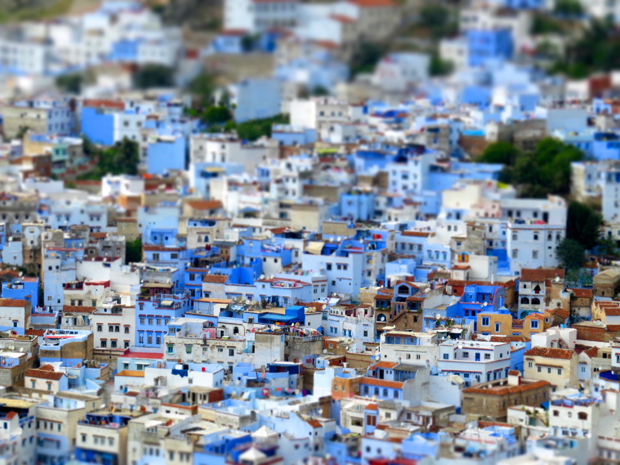
Day 4: Drive to Chefchaouen
This is the one real driving day of the week, about four hours. Leave after breakfast and you’ll be sitting down to a late lunch in Chefchaouen.
The road climbs into the Rif, which is Amazigh country and looks nothing like the plains you just left. Give the afternoon to the medina and do nothing with it except walk. Chefchaouen is small enough that you cannot get properly lost, and the blue is layered on by hand every year, so it reads as paint rather than a filter.
Eat the local goat cheese while you’re here. It’s a Rif thing and you won’t find much of it elsewhere in the country.
Day 5: Chefchaouen
- The Spanish Mosque at sunset. Twenty minutes uphill out of town, no entry fee, and the view back over the blue medina is the one you came for. Go up for sunset, not midday.
- Ras El Maa. The water source at the top of the medina where women still bring laundry. Sit at one of the cafes built over the stream.
- The kasbah and Plaza Uta el-Hammam. The square is where the town actually sits in the evening. Order something and stay a while.
- Akchour, if you want a hike. Forty-five minutes out, waterfalls and a natural rock bridge, and a half to full day on your feet. Skip it if the week is already full. Don’t attempt it in heavy rain.
Days 6 and 7: Tangier
Two and a half hours down from Chefchaouen. Tangier is the city in Morocco that feels least like the rest of Morocco, and that is its whole appeal. Spanish, French, American and Moroccan histories all sitting on top of each other, and a city that has spent the last decade rebuilding its waterfront.
- The kasbah and the Petit Socco. Start high and work down.
- Cafe Hafa. Open since 1921, built in terraces down the cliff, mint tea and the Strait of Gibraltar. On a clear day you can see Spain.
- The Tangier American Legation Museum. The oldest American diplomatic property outside the United States, and a much better museum than that description suggests.
- Dinner on the water. The corniche has changed completely in ten years and is worth an evening.
We run food experiences in Tangier, and this is the day for one. The food here reads differently to the rest of the country, more Spanish and more Atlantic, and our guides will take you to the places that explain why rather than the places with an English menu in the window.
Tangier Tour and Food Experiences
Day 7: Tangier properly, or Asilah. If you’re staying in the city, go west to Cap Spartel and the Caves of Hercules in the morning, about thirty minutes out, then come back for a long lunch and the Librairie des Colonnes.
If you’d rather see one more town, Asilah is forty-five minutes south. Whitewashed, Atlantic, ramparts you can walk, and murals that get repainted every summer for the arts festival. It’s also on the road and rail line south, so if you’re flying out of Casablanca it makes an easy stop on the way rather than a separate trip.
Fly out of Tangier if you can. If you can’t, the Al Boraq train gets you to Casablanca in a bit over two hours, which makes a morning flight the next day perfectly manageable.


If you want help with the week
You want one really good day in Tangier.
We run food experiences here, on set routes we’ve spent years building, with guides who grew up in these neighbourhoods. If you only outsource one day of this week, make it this one, because Tangier is the city on this route where a local completely changes what you see.
You’re planning the week yourself.
The Morocco Explorer Guide is the planning toolkit I’d hand a friend: the logistics, the booking order, what to pay for things, and the decisions already laid out so you’re not reverse-engineering them from forty browser tabs.
You’d rather not plan it at all.
We design and run private trips across Morocco, north included. If your honest reaction to the drive table above is that you don’t want to spend your evenings working out grand taxi routes between Fez and Chefchaouen, that’s exactly who we work with.